A trove of ancient coins has been unearthed at a construction site in Germany — after remaining hidden for more than 2,000 years.
The discovery, made at Singer Berg in the central German state of Thuringia, was announced recently by the Thuringian State Office for Monument Preservation and Archaeology (TLDA).
In a translated news release, officials said excavation director Ronny Krause discovered the coins while archaeologists were investigating a former sports field ahead of the construction of a new fire station.
7,000-YEAR-OLD BONES UNCOVERED AT CONSTRUCTION SITE IN STARTLING FIND
Archaeologists conducted follow-up excavations at the site in August 2026 — and confirmed that the 11 coins dated back to the first century B.C.
The hoard represented the largest known Celtic coin hoard from that period ever found in Thuringia.
The 11 coins, dating back to the first century B.C., were identified as a type of ancient Celtic currency known as Prague-type quinarii.
“Until now, only about 80 examples of these quinarii had been identified throughout Thuringia, underscoring the significance of the Singen hoard,” the translated statement said.
WORKERS RENOVATING MAJOR CITY STREET STUMBLE ON ANCIENT DISCOVERY BURIED 20 FEET BELOW
“The mint responsible for producing the coins is believed to have been located in the Gotha region, to the northwest.”
The Celts were groups of ancient people who lived across much of Europe during the Iron Age, with Celtic languages and traditions surviving today in places such as Ireland, Scotland and Wales.
The coins were originally buried together in a container made of organic material that has since decomposed, archaeologists believe. The coins were found scattered across an area measuring roughly 19 feet by 5 feet — likely a result of plowing.
Officials described the discovery as a “closed find,” suggesting that all the coins originally buried together were recovered.
CLICK HERE TO SIGN UP FOR OUR LIFESTYLE NEWSLETTER
While just 11 coins may seem like a modest haul to some, archaeologists consider the discovery a treasure trove of information about the ancient world.
“Through the ongoing mapping of discoveries from the same period and cultural background, researchers can draw conclusions about ancient trade routes and production centers,” the translated statement added.
“The Singen treasure hoard has significantly expanded our existing knowledge in this area.”
Archaeologists also found an ancient Roman coin and a medieval glass bead — as well as a knife fragment, another silver coin and a Prussian uniform button from the 19th or 20th century.
CLICK HERE FOR MORE LIFESTYLE NEWS
Officials also emphasized the broader significance of the discovery and the importance of proper archaeological practices.
“This once again demonstrates the importance of preserving the archaeological context of discoveries, in contrast to isolated metal finds recovered, for example, through improper or illegal metal detecting without documentation of their original locations,” the statement concluded.
TEST YOURSELF WITH OUR LATEST LIFESTYLE QUIZ
Metal detectorists have made headlines for uncovering other ancient treasures across Europe.
Recently, a man using a metal detector in a German field discovered 934 ancient Roman silver coins dating back nearly 2,000 years.
CLICK HERE TO DOWNLOAD THE FOX NEWS APP
In Finland, a metal detectorist recently uncovered a massive Viking Age silver hoard containing an estimated 4,000 coins, along with jewelry and other artifacts.
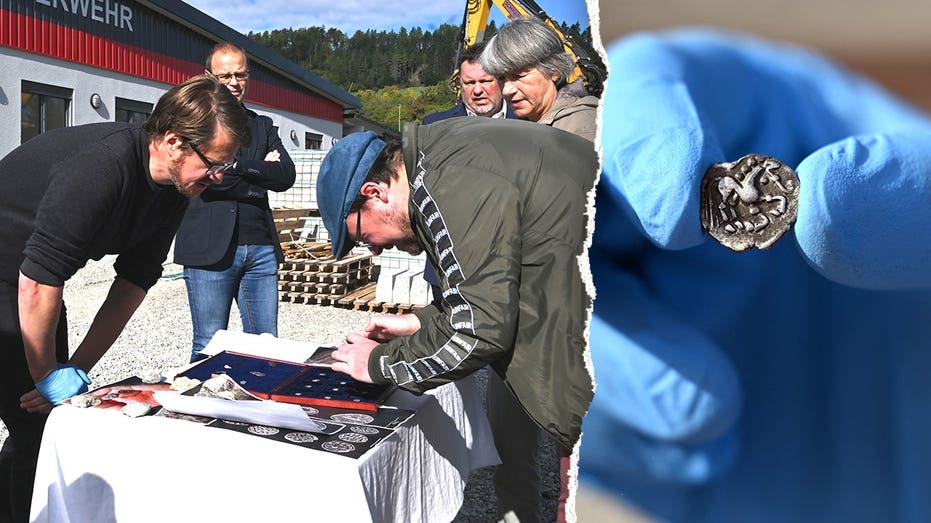
2,000-year-old treasure discovered beneath former sports field, breaking regional record
